


Walk into any senior care community and you’ll see a complex, carefully orchestrated environment.
Dining services are humming, residents are heading to appointments, and staff are managing countless interactions throughout the day. Every one of those moments often connects back to a transaction. And in many communities, those transactions are still being captured on paper.
Paper-based workflows introduce slow downs at nearly every step of the process, but going digital can change that. And, transitioning from paper-based to fully digital healthcare workflows reduced documented errors from 52.8% to 15.7%.
In this blog, we explore how the move toward digital point-of-sale (POS) systems can create a more connected, accurate, and seamless experience for staff, operators, and residents.
Paper workflows rely on people to capture, interpret, and re-enter information. That creates natural gaps.
Staff may spend their day writing down what each resident purchases and consumes such as a meal at lunch, a guest charge, or a salon visit. If that information isn’t entered into a system or entered promptly, it’s lost. And even when it is entered, there’s always a chance for error. This results in revenue loss and potential resident confusion.
Teams spend time reconciling transactions, staff interpret handwriting, managers chase down missing information, and month-end processes become time-consuming and stressful. While this work maintains the system, it doesn’t improve care or service nor is this process efficient.
Digital POS systems shift that dynamic entirely. By minimizing manual data entry and automating transaction capture, they remove layers of unnecessary work. What once required multiple steps becomes a seamless, real-time process.
In senior care, accuracy plays a role in the overall quality of service. For example, dining is a core part of daily life, contributing to satisfaction, routine, and well-being. When transactions are tracked inconsistently, it becomes harder to understand what residents are consuming and experiencing.
Transitioning from paper-based to fully digital healthcare workflows reduced documented errors from 52.8% to 15.7%.
Digital POS systems bring clarity back into the equation. Transactions can be recorded in real time, meal plans can be tracked automatically, and charges can be applied based on predefined rules. There is no need to rely on memory or manual follow-up.
For staff, this reduces guesswork. For operators, it creates clean, reliable data. And for each resident, it supports more consistent and dependable experiences.
One of the most significant challenges with paper-based healthcare POS workflows is how quietly revenue can slip through the cracks.
It rarely appears as a single, obvious issue. Instead, it shows up in small moments like missed charges, unrecorded service, or a delay in entering transactions.
With digital POS systems, transactions are captured at the point of service, charges are routed automatically based on system configuration, and billing files are clean and complete, ready to flow into financial systems without additional manipulation.
For senior care providers, this means fewer surprises and more reliable revenue.
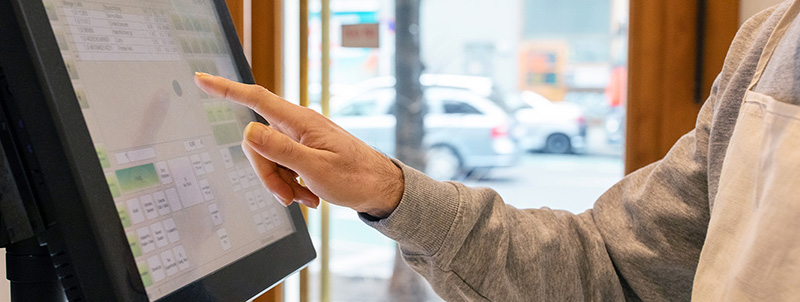
Every interaction at the point of service shapes how a resident feels about their community. When processes are manual, service can feel slower and less precise. Staff may need to pause to write something down, they may not have immediate access to a resident’s balance or meal plan status, and questions can take longer to answer.
That experience can be cumbersome for both staff and residents.
Digital POS systems remove those barriers.
With real-time visibility into balances and meal plans, staff can serve residents with confidence. There’s less guessing. Fewer delays. Minimal need for follow-up later.
For residents, that translates into faster service, fewer errors, and a more modern environment. It reinforces the feeling that they’re in a community that values both care and innovation.
As communities evaluate digital POS systems, it’s important to look beyond basic functionality and focus on capabilities that truly address the complexities of senior care. These include:
What communities need is a healthcare POS purpose-built to simplify a complex environment. RetailTracker was built specifically for long-term care environments, with a deep understanding of the operational and financial challenges faced every day.
At its core, RetailTracker unifies dining, retail, and ancillary transactions into a single POS system. Its native integration with MatrixCare helps ensure that resident profiles and billing data flow automatically across campus. When a resident is admitted, discharged, or updated, that information is reflected in real time. Charges are displayed automatically, minimizing missed entries, duplicate work, and billing disputes.
RetailTracker also brings advanced meal plan intelligence to the forefront. It supports prioritized plans, mixed payors, couple plans, and flexible cycles, allowing even the most complex organizations to manage billing with confidence and accuracy.
At the point of service, help ensure staff have immediate access to real-time balances and meal plan status. This supports less guesswork and faster, more informed interactions with residents.
The shift from paper to digital is already underway across the industry. It’s part of a broader movement toward smarter, more connected senior care technology. Organizations that embrace this shift are elevating the entire experience for residents and staff alike.
See what smarter point-of-sale system looks like in action.

Lavell Shears is an Associate Product Manager for Point of Sale at ResMed, blending a lifelong passion for hospitality with a deep commitment to enhancing the customer experience. Born and raised in Chicago and now based in Atlanta, Lavell began his career in the culinary and restaurant industry, where he developed strengths in leadership, service excellence, and creativity.
In 2014, he transitioned into healthcare technology, joining MatrixCare (then AOD Software) in Support before advancing through roles in Implementation as a Consultant and Senior Consultant. These experiences strengthened his product expertise and deepened his understanding of customer needs across the care continuum.
Today, Lavell brings his problem solving mindset, collaborative spirit, and customer first perspective to product management, where he’s driven by a passion for building solutions that make a meaningful impact. Outside of work, he continues to express his creativity through cooking—his first love and favorite way to bring people together.


Start by having a call with one of our experts to see our platform in action.