


Healthcare has always been personal. Each resident and family brings their own history, preferences, goals, and clinical needs. What’s changing is what personalized care now looks like.
Today’s residents and families expect the same experiences they receive from nearly every other part of their lives. Whether they’re ordering groceries, managing finances, or booking travel, people expect seamless experiences. Healthcare is no exception.
As those expectations continue to climb, providers are navigating a persistent staffing shortage, increasing regulatory demands, growing clinical complexity, and mounting pressure to improve operational efficiency. At the same time, organizations are making significant technology investments in AI, automation, interoperability, and analytics to help them scale.
How can organizations deliver more personalized care while at the same time standardizing workflows, automating processes, and creating greater consistency? The answer is that they aren’t competing priorities at all.
In this blog, we explore why care organizations don’t have to choose between personalization and standardization by focusing on:
Person-centered care isn’t a new idea. Its roots go back decades, shaped by ideas about dignity, choice, and autonomy that have long influenced healthcare and long-term care. The philosophy has been here for years. What’s changed is the bar.
Residents and families now walk into a care setting comparing it to other services they experience, from same-day delivery to on-demand. That shift in expectations is putting greater emphasis on convenience, responsiveness, and personalization.
And it’s landing at the worst possible time for staffing. Nursing shortages are already stretching teams thin, and an aging population is creating a significant gap between supply and demand. Providers need to deliver more personalized resident experiences with fewer hands on deck, which is exactly why technology investment has become non-negotiable rather than optional.
Standardization can sound like the opposite of individualized care, but that reputation is undeserved. It’s about building a dependable foundation so teams can deliver personalized care on top of it.
When core workflows are consistent, a few great things happen:
When workflows vary wildly between care staff, shifts, and locations, documentation gets inconsistent, and that undermines trust in the data itself. Once that trust cracks, AI insights become less useful because the underlying data isn’t stable.
Standardization is what keeps that foundation solid, which frees up care staff to spend their energy on the resident in front of them rather than fighting the system.

Standardization can become a problem the moment systems shift from guiding decisions to dictating them. Healthcare is nuanced, and real-world care rarely fits into a rigid workflow. When systems get overly prescriptive, clinicians end up spending more energy satisfying the software than responding to what’s happening with their resident.
Think about wound care. One resident has a simple healing skin tear while another has a complex chronic wound needing close monitoring. Force both through the exact same rigid documentation cadence, and clinicians start documenting for the system instead of the resident. That’s when separate notes and manual workarounds appear because the tool stopped fitting the job.
The best systems avoid this by building flexible structure instead of rigid process. They standardize the foundational workflow and data model, while still giving clinicians room for informed decision-making. And AI and automation should support decision-making, not replace it.
A lot of organizations equate more information with more personalization, but more data without relevance just creates noise.
Picture a nurse getting fall risk, nutrition, mobility, and medication alerts for each resident, during each shift. That’s personalization based on data, but it’s also alert fatigue. Important signals can get lost in the pile of low-value ones. When that happens over and over, care staff prioritize the residents in front of them and quietly stop using the tool that isn’t helping.
Effective workflow automation should quietly support better decisions in the background, reducing cognitive burden instead of adding to it.
Organizations that balance personalization and consistency tend to share a few habits:
Designing for both personalized care and operational efficiency from the start means you don’t have to choose just one.
The organizations that come out ahead will standardize the framework while personalizing the experience and outcomes built on top of it. That’s exactly MatrixCare’s approach.
MatrixCare brings together connected workflows, automation, data, and AI to help providers create a more consistent foundation for care. With the right information easier to access within everyday workflows, teams can spend less time sorting through noise and more time responding to the needs of each resident and patient.
Addressing today’s staffing challenges doesn’t have to mean choosing between consistency and personalization. With the right foundation in place, organizations can offer both.
As our Head of Nursing and Clinical Informatics, Allison Rainey oversees the deployment of clinical technologies. As a Registered Nurse and License Family Practitioner, Allison drives a caregiver-first approach in our products, collaborating closely with product leaders to ensures our products and services prioritize the needs and challenges faced by healthcare providers. By aligning workflows, designs, and overall product strategy, Allison strives to offer the most user-friendly, clinically superior, and efficient suite of comprehensive solutions in the industry. Allison brings extensive post-acute care experience from her 20-year tenure at NHC, one the largest publicly traded Senior Care providers in the U.S. She is a seasoned leader in population health management strategy, clinical reporting and analytics development, and inpatient hospital care. In her most recent role as AVP of Clinical Information Technology, she oversaw the deployment and utilization of various clinical technologies, including the MatrixCare EHR, across the extensive NHC network. Allison holds a Bachelor’s and a Master’s in Nursing from the University of Tennessee.
See how MatrixCare can help your organization deliver more personalized care.

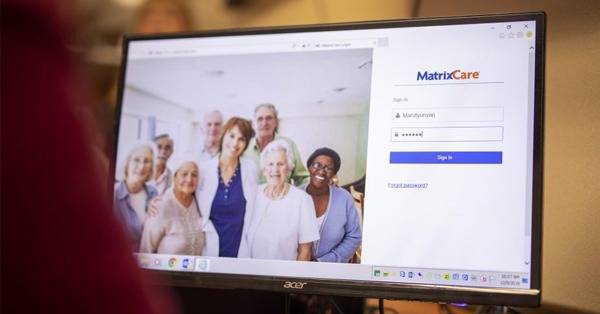

Start by having a call with one of our experts to see our platform in action.